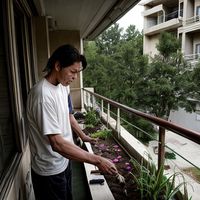
Writer Ge Fang wrote in her book "Vague Jiangnan" that her brother-in-law was a young hooligan when he was young. He was always fighting and getting into trouble everywhere, which made her sister live in constant fear. By the time he reached middle age, however, his temperament had changed dramatically. He planted flowers and grass in the front and back yards, spending all day hunched over taking care of them. In his free time, he would also go fishing and climbing mountains. When his sister came back late from playing mahjong outside, he wouldn't complain or get angry. Instead, he would voluntarily take in the sheets on the balcony and fold them neatly.
This middle-aged man would open the door every morning, look at the plants in the yard and say, "Ah, it makes me feel more comfortable than seeing my wife—they are so lively and full of the vitality of the earth."
When reading this, I couldn't help but be deeply touched—how powerful the plants are! They can transform a fierce and hot-tempered man into such a gentle and leisurely one.
When reading the book "Words of Branches and Grass", I discovered that there was actually the profession of "horticultural therapist".
Ms. Feng Wanyi is the chief horticultural therapist in Hong Kong. When she worked at an elderly care center in the past, because of her love for flowers and plants, she often took care of a small garden in the center in her spare time. When she managed to turn this almost deserted small garden into a lively and vibrant place full of vitality, it unexpectedly attracted the elderly patients in the center. These elderly people who had lost interest in almost everything took the initiative to come to the garden to water the plants and till the soil.
Ms. Feng was surprised to find that the elderly people who used to have very low concentration could water the plants in the garden for half an hour without any problem. She was astonished by the great magic of this small garden. After looking through relevant materials to seek an explanation, she discovered that the profession of "horticultural therapy" had already been quite popular in Europe and America.
After that, Ms. Feng designed flower beds of different heights for the elderly with limited mobility. For the elderly with dementia, she used bright flowers and their fragrance to stimulate them and arouse their lost memory and senses. Some elderly people with strange tempers actually became cheerful and gentle by taking care of the flowers and plants. The elderly changed from being the ones taken care of to the caretakers of the plants, finding their life values in the process, which also made Ms. Feng see the magic of "horticultural therapy".
Looking back on the past few years when I planted flowers, I gradually changed from an anxious and impatient woman into a gentle and calm one. It seems quite magical, but it does have its own reason, and that is the power of plants.
Plants can make people calm, not only in the moments when you are with them, but also in the process when you carefully take care of them.
Concentrating on doing one thing will make the mind simple and peaceful. When I face these simple and pure plants, I am also infected by their simplicity and purity.
As the saying goes, "One takes on the attributes of one's associates." If we spend more time with plants, we will naturally become as calm and composed as plants.
.png)
By Lily Simpson/Dec 21, 2024

By Noah Bell/Dec 21, 2024

By Laura Wilson/Dec 21, 2024
By Emma Thompson/Dec 21, 2024

By Samuel Cooper/Dec 21, 2024

By Eric Ward/Dec 21, 2024

By Jessica Lee/Dec 21, 2024

By Megan Clark/Dec 21, 2024
By Thomas Roberts/Dec 21, 2024

By Emily Johnson/Dec 21, 2024

By Sophia Lewis/Nov 28, 2024

By Daniel Scott/Nov 28, 2024